
Allergy or Parasites
Immunoglobulin E (IgE) plays a central role in both allergic disease and defence against parasitic infections. It is essential for protection against helminths, yet it also drives allergic inflammation. This dual function creates diagnostic and therapeutic challenges, especially in regions where parasites and allergy coexist.
This review explores
– the structure and function of IgE
– its role in parasitic infections
– molecular mechanisms of allergic disease
– diagnostic strategies
– current and emerging treatments
– key research gaps and future directions
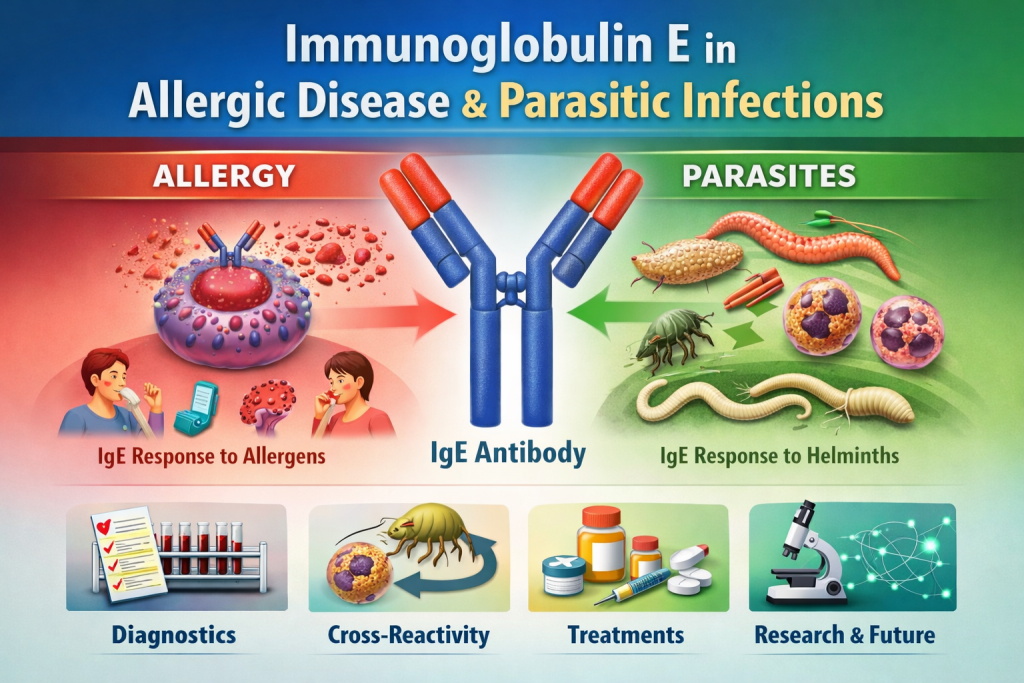
Immunoglobulin E (IgE) in allergic disease and parasitic infections – visual overview of immune mechanisms, diagnostics, cross-reactivity, and treatment pathways.
Key Mediators in IgE-Mediated Responses
Preformed mediators
– Histamine
– Tryptase
– Heparin
Newly synthesised mediators
– Leukotrienes C₄, D₄, E₄
– Prostaglandin D₂
– Thromboxanes
Cytokines and chemokines
– IL-4, IL-5, IL-13
– TNF-α
– CCL3, CCL5, CCL11
– TGF-β
IgE and Parasitic Infections
Soil-transmitted helminths commonly associated with IgE elevation include
– Ascaris lumbricoides
– Strongyloides stercoralis
– Trichuris trichiura
– hookworms (Necator americanus and Ancylostoma duodenale)
These infections stimulate IgE-mediated immune pathways that may
– support parasite expulsion
– enhance epithelial barrier integrity
– increase mucus production
– activate eosinophils
Molecular Cross-Reactivity
Helminth-derived proteins with allergenic potential include
– tropomyosins
– glutathione S-transferases
– paramyosins
Cross-reactivity is particularly relevant for
– house dust mite allergy
– asthma in parasite-endemic regions
– interpretation of IgE test results
Diagnostic Approaches
In vivo testing
– Skin prick testing (SPT) – first-line, rapid, high sensitivity
– Intradermal testing (IDT) – higher sensitivity, lower specificity
In vitro testing
– Total IgE – supportive but non-specific
– Allergen-specific IgE (sIgE) – clinically useful when correlated with history
– Component-resolved diagnostics (CRD) – improves specificity and reduces false positives
Functional assays
– Basophil activation test (BAT) – high specificity but limited availability
Therapeutic Strategies
Management of IgE-mediated disease typically includes
– allergen avoidance
– patient education and written action plans
– pharmacotherapy (antihistamines, corticosteroids, leukotriene antagonists)
– adrenaline auto-injectors for anaphylaxis
Advanced interventions include
– allergen immunotherapy (SCIT, SLIT, OIT)
– biological therapies such as omalizumab
– emerging cytokine-targeted monoclonal antibodies
References
1. Santos AF, Riggioni C, Brough HA, et al. EAACI guidelines on the management of IgE-mediated food allergy. Allergy. 2025;80(1):14-36. doi:10.1111/all.16345
2. Caraballo L, Coronado S. Parasite allergens. Mol Immunol. 2018;100:113-119. doi:10.1016/j.molimm.2018.03.014
3. Arrais M, Maricoto T, Nwaru BI, et al. Helminth infections and allergic diseases: systematic review and meta-analysis of the global literature. J Allergy Clin Immunol. 2022;149(6):2139-2152. doi:10.1016/j.jaci.2022.01.028
4. Jogi NO, Kitaba N, Storaas T, et al. Ascaris exposure and its association with lung function, asthma, and DNA methylation in Northern Europe. J Allergy Clin Immunol. 2022;149(6):1960-1969. doi:10.1016/j.jaci.2022.01.008
5. Cooper PJ, Figueiredo CA, Rodriguez A, et al. Understanding and controlling asthma in Latin America: a review of recent research informed by the SCAALA programme. Clin Transl Allergy. 2023;13(3):e12232. doi:10.1002/clt2.12232
6. Ansotegui IJ, Melioli G, Canonica GW, et al. IgE allergy diagnostics and other relevant tests in allergy, a World Allergy Organization position paper. World Allergy Organ J. 2020;13(2):100080. doi:10.1016/j.waojou.2019.100080
7. Immunoglobulin E (IgE): Function, Tests & Disorders. Cleveland Clinic. https://my.clevelandclinic.org/health/body/ige. Updated June 12, 2025. Accessed August 29, 2025.
8. Caraballo L, Puerta L, Zakzuk J. The Relationship of Parasite Allergens to Allergic Diseases. Curr Allergy Asthma Rep. 2023;23(7):363-373. doi:10.1007/s11882-023-01089-8
9. The Relationship of Parasite Allergens to Allergic Diseases. Parasites & Vectors. 2023;16(1):363. doi:10.1007/s11882-023-01089-8
10. Wang J, Wang W, Wang Y, et al. A systematic review of total IgE reference intervals – A 2024 update. Clin Chim Acta. 2025;566:120024. doi:10.1016/j.cca.2024.120024