
Allergy and Immunology Clinics in London
London Allergy and Immunology Centre
Comprehensive Allergy Diagnosis and Treatment in London
Introduction
Allergy and Clinical Immunology is a core medical specialty focused on the diagnosis, treatment, and long-term management of allergic diseases. The prevalence of allergies has increased significantly over recent decades, particularly in industrialised countries such as the United Kingdom.
At our private Allergy and Immunology clinic in London, we provide a comprehensive, personalised, and evidence-based approach to allergy care. Using advanced diagnostic technologies and modern therapeutic protocols, we support both adults and children affected by allergic conditions.
Allergic diseases affect an estimated 10–25% of the population, commonly impacting school-aged children and working-age adults. These conditions can significantly reduce quality of life and place a substantial burden on healthcare systems and families. Our goal is to deliver precise diagnosis and effective treatment to improve long-term outcomes.
Our Facilities and Specialist Team
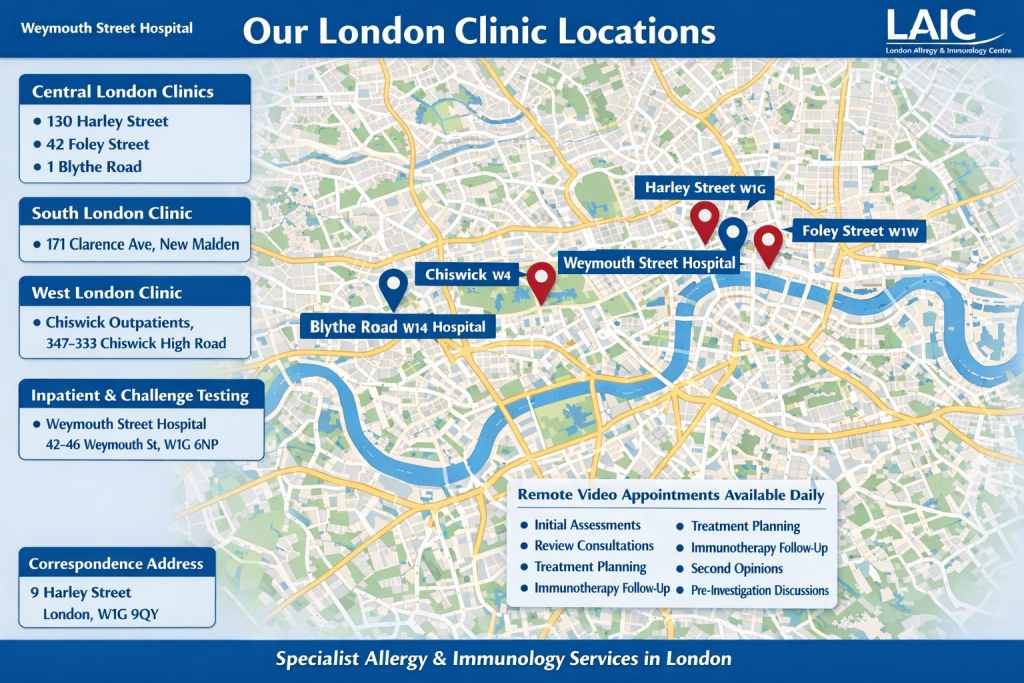
Our clinic is located in the prestigious Harley Street medical district in Central London and equipped with state-of-the-art allergy diagnostic and treatment facilities.

Our facilities include:
- Dedicated consultation rooms
- Advanced allergy testing units
- Treatment and monitoring suites
- Recovery areas designed for patient safety and comfort
Our multidisciplinary team includes consultant allergists and immunologists, specialist nurses, and experienced laboratory staff. All clinicians are trained at internationally recognised centres of excellence and follow UK and international clinical guidelines.
Understanding Allergic Diseases
Allergic diseases result from an exaggerated immune response to normally harmless environmental substances known as allergens. These reactions are typically mediated by Immunoglobulin E (IgE) and involve inflammatory cells such as mast cells, eosinophils, basophils, and Th2 lymphocytes.
The release of inflammatory mediators including histamine, leukotrienes, and cytokines (IL-4, IL-5, IL-13) leads to symptoms affecting:
- The nose (allergic rhinitis / hay fever)
- The eyes (allergic conjunctivitis)
- The lungs (allergic asthma)
- The skin (eczema, urticaria, angioedema)
Advanced Allergy Diagnostic Services in London
Comprehensive Clinical Assessment
Every patient undergoes a detailed clinical assessment, including:
- Medical history and symptom analysis
- Identification of triggers and symptom patterns
- Full physical examination
This assessment guides the selection of appropriate allergy tests.
Allergy Testing
Skin Prick Testing
Skin prick testing is a first-line allergy test due to its high sensitivity, specificity, and rapid results.
- Tests common allergens such as pollens, dust mites, animal dander, and moulds
- Performed on the forearm
- Results available within 15–20 minutes
A positive result is defined as a wheal ≥3 mm with surrounding redness.
Blood Tests for Specific IgE
Blood tests measure specific IgE antibodies using validated laboratory methods (e.g. ImmunoCAP).
These tests are suitable for:
- Patients unable to stop antihistamines
- Individuals with skin conditions
- Complex or unclear clinical presentations
Molecular Allergy Diagnosis (Component-Resolved Diagnostics – ALEX)
We offer advanced molecular allergy testing in London using the ALEX (Allergy Explorer) platform. This test analyses IgE sensitisation to over 300 allergen components from a small blood sample.
Molecular diagnostics allow us to:
- Differentiate true allergy from cross-reactivity
- Identify high-risk allergen components
- Predict severity and persistence of symptoms
- Optimise allergen immunotherapy selection

This precision approach improves diagnostic accuracy and treatment outcomes.
Respiratory and Asthma Testing
For patients with suspected or confirmed asthma, we provide:
- Spirometry with bronchodilator testing
- Methacholine bronchial challenge testing
- Fractional exhaled nitric oxide (FeNO) testing
These tests help confirm diagnosis, assess disease severity, and monitor treatment response.
Additional Investigations
When indicated, we may also perform:
- Nasal, conjunctival, or bronchial provocation tests
- Imaging studies (e.g. sinus CT scans)
- Inflammatory cell analysis
Personalised Allergy Treatment in London
Allergen Avoidance and Environmental Control
Based on test results, we provide tailored advice on allergen avoidance, including practical strategies to reduce exposure to indoor and outdoor allergens.
Medical Treatment
We prescribe evidence-based allergy medications in line with international guidelines, including:
- Non-sedating antihistamines
- Intranasal and inhaled corticosteroids
- Leukotriene receptor antagonists
- Bronchodilators
Treatment is always individualised based on patient needs and preferences.
Allergen Immunotherapy (AIT)
Allergen immunotherapy is the only disease-modifying treatment for allergic disease.
Sublingual Immunotherapy (SLIT)
SLIT is our preferred immunotherapy option due to its strong safety profile and convenience.
- Administered as drops or tablets under the tongue
- First dose supervised, then taken at home
- Daily treatment for 3–5 years
SLIT has been shown to:
- Reduce symptoms and medication use
- Prevent progression from rhinitis to asthma
- Reduce development of new allergies
Subcutaneous immunotherapy (SCIT) is no longer routinely used due to higher systemic reaction risk.
Biological Therapies
For patients with severe or uncontrolled allergic asthma, we offer advanced biological treatments including:
- Anti-IgE therapy (omalizumab)
- Anti-IL-5 therapies (mepolizumab, benralizumab, reslizumab)
- Anti-IL-4/IL-13 therapy (dupilumab)
- Anti-TSLP therapy (tezepelumab)
Safety, Monitoring, and Follow-Up
Patient safety is central to all our services.
- All staff are trained in managing allergic reactions and anaphylaxis
- Regular follow-up ensures treatment effectiveness and safety
- High-risk patients may receive treatment under day-case medical supervision
Research and Innovation
Our London Allergy and Immunology Centre actively participates in clinical research and innovation, collaborating with national and international academic institutions. We continuously update our protocols in line with guidance from leading allergy organisations.
Conclusion
At our Allergy and Immunology clinic in London, we provide a comprehensive, personalised, and evidence-based approach to allergy diagnosis and treatment. From advanced molecular diagnostics to immunotherapy and biological treatments, we aim not only to control symptoms but to modify the natural course of allergic disease.
Our mission is to deliver outstanding allergy care to patients across London and the UK.