Latest News and Info

Early SLIT Immunotherapy for Hay Fever and Asthma Prevention London

SLIT Immunotherapy London

Early SLIT Immunotherapy: Could Treating Hay Fever Earlier Help Protect Against Asthma?

New medical evidence suggests that sublingual allergen immunotherapy (SLIT) may be more than symptom control. For carefully selected patients, it may help change the long-term course of allergic rhinitis and allergic asthma.

Key message

SLIT immunotherapy is increasingly being viewed as a disease-modifying treatment for allergic rhinitis and allergic asthma, rather than only a final option when antihistamines and nasal sprays are not enough.

What is SLIT immunotherapy?

Sublingual allergen immunotherapy (SLIT) is a specialist allergy treatment designed to gradually train the immune system to tolerate a specific allergen. It may be used for selected patients with allergic rhinitis, allergic conjunctivitis and allergic asthma caused by triggers such as grass pollen, tree pollen, house dust mite or animal dander.

Unlike standard medicines, which mainly reduce symptoms while they are being taken, SLIT aims to reduce the body’s allergic response over time. Treatment is usually administered as liquid allergen drops under the tongue according to the prescribed treatment plan.

How SLIT works

Small amounts of allergen are introduced regularly under the tongue to encourage immune tolerance over time. The treatment plan is individualised according to the allergen profile, symptoms and medical history.

Why is earlier treatment being discussed?

A 2026 expert review in Current Opinion in Allergy and Clinical Immunology highlights a shift in thinking. Traditionally, allergen immunotherapy was often considered only after symptoms remained troublesome despite medication. However, newer real-world evidence suggests that starting immunotherapy earlier in suitable patients may offer a “window of opportunity” to influence the natural history of allergic airway disease.

This is particularly relevant for patients with persistent allergic rhinitis, with or without mild to moderate allergic asthma. Allergic rhinitis and asthma are closely linked, and untreated or poorly controlled nasal allergy may contribute to lower airway symptoms in some patients.

Potential benefits of earlier SLIT immunotherapy

  • Reduced need for long-term allergy medication
  • Improved control of allergic rhinitis symptoms
  • Fewer severe asthma exacerbations in some patient groups
  • Possible reduction in the risk of developing asthma
  • Possible reduction in the development of new allergen sensitisation
  • Long-lasting benefit after completion of treatment in selected patients

What does recent evidence show?

Large real-world studies, including the REACT programme and the EfficAPSI study, suggest that adding allergen immunotherapy to standard care may reduce medication use, severe asthma exacerbations and healthcare use over long-term follow-up.

The 2026 review also highlights that younger patients may gain particular benefit when treatment is started before allergic airway disease becomes more established. This supports the idea that allergic rhinitis should not always be viewed as a minor condition, especially when symptoms are persistent, seasonal year after year, or associated with wheeze, cough or exercise-related breathing symptoms.

Who may be suitable for SLIT immunotherapy?

SLIT is not suitable for everyone. It should only be considered after specialist allergy assessment, including a careful clinical history and confirmation that symptoms match relevant IgE sensitisation on skin prick testing or blood testing.

You may be considered if you have:

  • Moderate to severe hay fever
  • Persistent house dust mite allergy
  • Allergic rhinitis with confirmed pollen, mite or animal allergy
  • Symptoms despite regular antihistamines or nasal sprays
  • Allergic asthma that is mild to moderate and controlled enough for treatment

A specialist review is essential if you have:

  • Uncontrolled asthma
  • A history of severe allergic reactions
  • Multiple allergies requiring prioritisation
  • Other medical conditions or regular medication
  • Uncertainty about the main allergen causing symptoms

Why accurate diagnosis matters

The success of SLIT depends on selecting the correct allergen. For example, a patient with spring symptoms may be reacting to birch pollen, grass pollen, plane tree pollen, or more than one pollen. A patient with year-round symptoms may have house dust mite allergy, animal dander allergy, mould allergy, non-allergic rhinitis, or a combination of causes.

At a consultant-led allergy clinic, testing may include skin prick testing, specific IgE blood testing and, where appropriate, molecular allergy testing. This helps confirm whether immunotherapy is likely to be clinically relevant and which allergen should be prioritised.

Early treatment does not mean rushed treatment

Earlier SLIT means considering disease-modifying treatment before allergic disease progresses further. It does not mean starting treatment without proper assessment. The allergen profile, safety considerations and asthma control must all be reviewed carefully.

How long does treatment take?

SLIT immunotherapy is usually a long-term commitment. Many treatment courses continue for around three years, depending on the allergen and clinical response. The aim is to achieve sustained immune tolerance and longer-lasting benefit, rather than short-term symptom relief only.

Can SLIT replace antihistamines and nasal sprays?

Not immediately. Symptomatic treatment remains important, especially during the early stages of immunotherapy and during high pollen exposure. Many patients continue to use nasal sprays, antihistamines or eye drops as needed. Over time, some patients may need less medication, but this should be reviewed individually.

Why choose a specialist allergy clinic?

SLIT should be prescribed and monitored by clinicians experienced in allergy diagnosis, asthma assessment and immunotherapy safety. A specialist clinic can help identify the most relevant allergen, assess asthma risk and monitor response throughout the course.

Considering SLIT immunotherapy for hay fever, dust mite allergy or allergic asthma?

A consultant-led allergy assessment can help determine whether SLIT immunotherapy is appropriate for you or your child.

Book an Allergy Consultation

Summary

SLIT immunotherapy is increasingly recognised as a treatment that may modify the course of allergic respiratory disease. For suitable patients with confirmed allergic rhinitis, and especially those at risk of asthma progression, earlier discussion of immunotherapy may be clinically valuable.

The decision should always be personalised. The most important first step is accurate diagnosis, followed by careful selection of the correct allergen treatment plan.

Medical disclaimer: This article is for general information only and does not replace medical advice. Immunotherapy should only be started after assessment by an appropriately qualified allergy specialist.

References include: Lombardi C. et al. Allergen-specific immunotherapy at earlier stages of allergic respiratory diseases. Current Opinion in Allergy and Clinical Immunology. 2026; ARIA-EAACI allergic rhinitis guidance; AAAAI, London Allergy and Immunology Centre’s patient information on allergy immunotherapy.

Urticaria Allergic rhinitis Mental health

ACARE & UCARE Accredited Centre

Mind, Mucosa and Skin

How chronic urticaria, allergic rhinitis and psychological wellbeing can affect one another

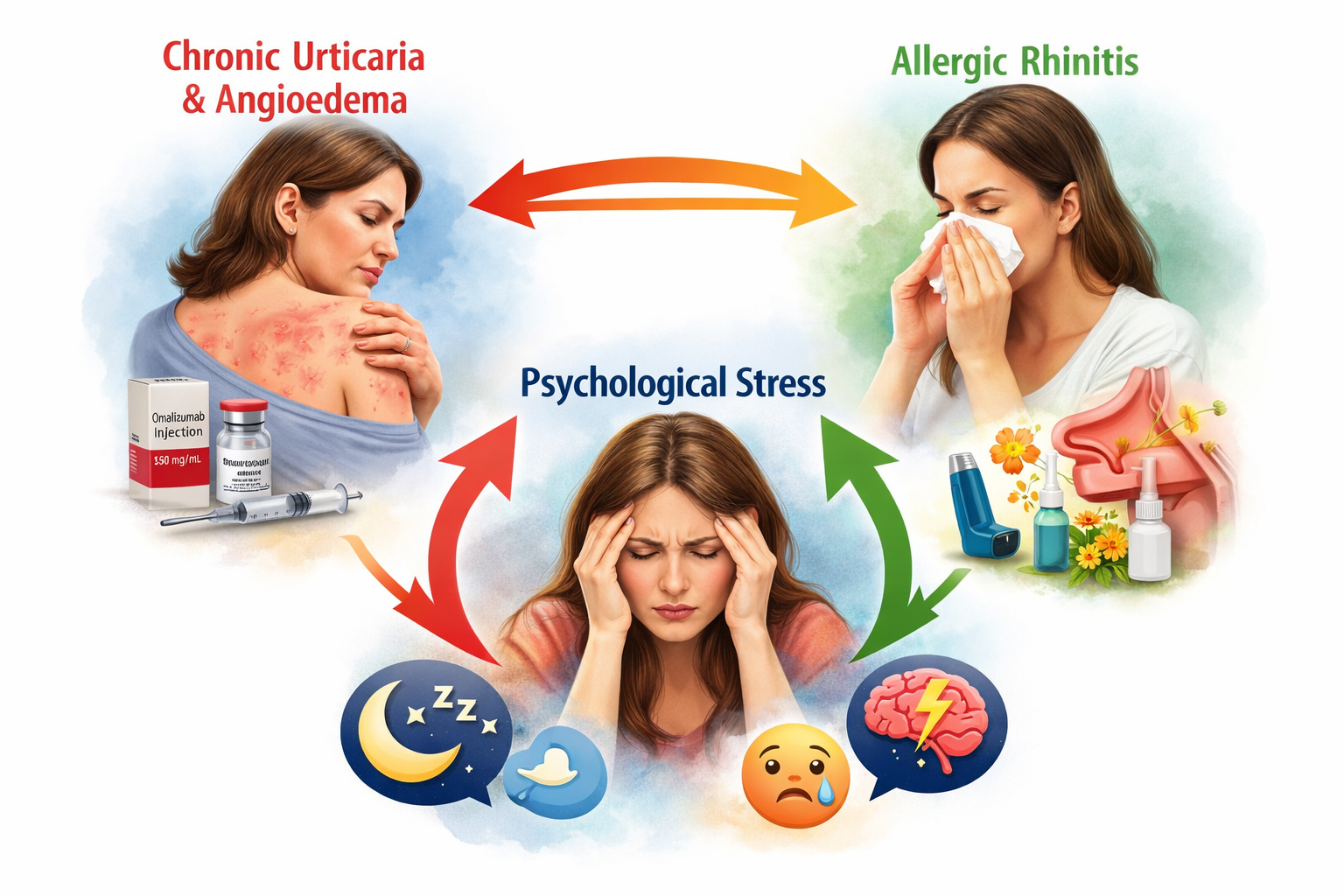
At the London Allergy and Immunology Centre, we take a whole-person view of allergy care. New research highlights that chronic spontaneous urticaria, nasal allergy symptoms and emotional wellbeing are often closely connected. This matters because better understanding of this link can help patients access more complete and effective care.

The link between chronic urticaria hives, allergic rhinitis symptoms and psychological stress in allergy patients

The connection between chronic urticaria, allergic rhinitis and psychological stress affecting overall wellbeing.

Why this matters for patients with allergy and urticaria

Chronic spontaneous urticaria, often called CSU, is more than a skin rash. It can disrupt sleep, affect confidence, interfere with work and family life, and create constant uncertainty because symptoms may flare without warning. When allergic rhinitis is also present, the burden can become even greater. Nasal blockage, sneezing, poor sleep and persistent irritation may add to fatigue and emotional strain.

A 2026 study explored this triad of mind, mucosa and skin and showed that psychiatric comorbidities were very common among adults with antihistamine-refractory CSU receiving omalizumab. The findings support a more integrated model of care in which allergy, skin symptoms, sleep and mental wellbeing are considered together rather than separately.

What is chronic spontaneous urticaria?

Urticaria is characterised by itchy raised wheals, angioedema, or both. When symptoms persist for more than 6 weeks, the condition is defined as chronic urticaria. If the rash and swelling occur without a clear external trigger, it is called chronic spontaneous urticaria.

Many patients improve with antihistamines, but some continue to have frequent symptoms despite treatment. In these more difficult cases, specialist assessment is important to confirm the diagnosis, identify associated conditions, assess disease activity properly and consider advanced treatment options such as omalizumab where appropriate.

Common features of CSU
– Recurrent itchy wheals
– Swelling of the lips, eyelids, hands or other areas
– Symptoms lasting longer than 6 weeks
– Unpredictable flare-ups
– Sleep disturbance and reduced quality of life

What did the 2026 study find?

The study reviewed 72 adults with antihistamine-refractory CSU who received omalizumab and had a formal psychiatric evaluation at a tertiary allergy centre between 2015 and 2025. Most participants were female, with a median age of 45 years. Psychiatric diagnoses were identified in 90.3% of the cohort who underwent psychiatric assessment.

The most frequent psychiatric diagnostic group was anxiety disorders, followed by mood disorders and sleep-wake disorders. Generalised anxiety disorder was the single most common diagnosis. The authors also reported that allergic rhinitis was present in more than half of the cohort, suggesting an important upper-airway allergic burden in this patient group.

Study finding Result
Patients included 72 adults with antihistamine-refractory CSU treated with omalizumab
Female participants 70.8%
Median age 45 years
Any psychiatric comorbidity 90.3%
Most common psychiatric group Anxiety disorders
Allergic rhinitis in the cohort 51.4%

The stress-skin connection in chronic urticaria

Patients often tell us that stress seems to aggravate their hives. This fits with what clinicians and researchers have observed for many years. Chronic urticaria can itself be stressful because flare-ups are unpredictable and visible. At the same time, stress may influence inflammatory pathways, itch perception and symptom severity, which can then further increase anxiety and distress. This creates a self-perpetuating cycle.

The 2026 paper describes this as a close interaction between psyche and skin. Biological pathways thought to be involved include stress-related neuroimmune signalling and mast cell-mediated inflammation. For patients, the important message is simple: the symptoms are real, the burden is real, and both the physical and emotional impact deserve proper attention.

This does not mean urticaria is “just stress”. Rather, it means stress, sleep problems, allergy symptoms and inflammation may all affect one another. That is why good management often requires more than a prescription alone.

Response to treatment in the study

Under omalizumab treatment, disease control improved significantly in this cohort. Median UAS7 scores fell from 42 before treatment to 7 at 24 months, while UCT scores rose from 0 to 14. These results support the role of specialist treatment in patients whose symptoms remain poorly controlled on antihistamines alone.

The authors also noted that improving urticaria control may bring psychological benefits and better emotional wellbeing. In practice, this reinforces the importance of identifying uncontrolled disease early and ensuring that patients receive an expert review rather than simply repeating ineffective treatment.

What this means for care at our ACARE and UCARE accredited centre

As an ACARE and UCARE accredited centre, we believe patients with chronic urticaria deserve expert, evidence-based and compassionate care. This includes careful diagnosis, assessment of angioedema and inducible triggers, review of coexisting allergic diseases such as allergic rhinitis and asthma, and evaluation of how symptoms are affecting sleep, mood and daily functioning.

Where appropriate, management may involve optimisation of antihistamines, consideration of advanced treatment pathways, investigation of associated conditions and practical support around trigger awareness, sleep hygiene and stress reduction. In some cases, collaboration with other professionals may be helpful so that care is truly patient-centred and holistic.

For patients, the key message is that severe hives and swelling are not only skin symptoms. They can affect confidence, sleep, relationships and quality of life. Recognising that full burden is an important step towards better outcomes.

When to seek specialist urticaria assessment

– Your hives or swelling have lasted longer than 6 weeks
– Symptoms keep returning despite antihistamines
– You have troublesome angioedema
– Sleep is regularly disturbed by itch or nasal symptoms
– You feel that stress, anxiety or low mood are making symptoms harder to manage
– You may have both urticaria and allergic rhinitis

Book an expert review

If you are living with chronic hives, angioedema or allergic rhinitis, our specialist team can help assess the full picture and create a personalised plan. We offer consultant-led allergy care with a focus on accurate diagnosis, better symptom control and improved quality of life.

Book an appointment

Reference

This article is based on the 2026 paper by Zeynep Yegin Katran, İsmet Bulut, Andaç Salman, Ali Baz, Galip Muzaffer Kürşat Küçükali and Özge Argın, which examined the relationship between chronic spontaneous urticaria, allergic rhinitis and psychiatric comorbidities in omalizumab-treated adults.

Please note that this blog is for general education and does not replace personalised medical advice. Diagnosis and treatment should always be based on an individual clinical assessment.

Why you shouldn’t ignore your seasonal allergies

seasonal allergies

Why you shouldn’t ignore your seasonal allergies

We’ve spent a lot of time talking about seasonal allergies – or, as they’re also known, hay fever or allergic rhinitis. There are plenty of blogs on this very site talking about dos and don’ts, what you can do to make them better, and even how climate change can make them worse.

But still, it’s only hay fever, right? What’s the worst that can happen from a sniffly nose or itchy eyes? It’s not as if it’s life or death. Having such a blasé approach to your allergies can do more harm than good – even for a mild seasonal allergy. Let’s look at how you could be making your life more difficult by ignoring yours.

It’s not going to get better

While the symptoms might be annoying at the start, some people think they can just get used to them. They’ll go away on their own eventually, so why bother worrying about it now? Except our body isn’t going to magically heal or grow tolerant of the pollen. That’s the reason it’s reacting in the first place.

Even if you wait, you might be waiting for a long time. Due to climate change, pollen seasons seem to be starting earlier and lasting longer. In one study, they increased by 20 days between 1990 and 2018. And pollen concentrations have gone up 21% over that same time period.

It’s not something to ignore because it’s going to be constantly reminding you it’s there. Ask yourself, do you really want to be dealing with this for months and months?

In fact, it might get worse

As we said, allergies don’t just disappear. You might notice your seasonal allergies affect you less depending on where you are in the world, but your body’s intolerance to them won’t go away. They might do the complete opposite.

People can develop allergies at any age, and it stands to reason that they can get increasingly worse over time, too. Why this happens is hard to pin down, though some speculate repeated exposure to an allergen has its negative effects over the years. So while you try to ignore your allergies, they won’t be going anywhere. And the more you avoid taking the steps to address them, the more chance you give them to develop.

It’s not going to be nice

There can be a tendency with seasonal allergies to “wait out the storm”, as it were. After all, pollen season only lasts so long. Give it enough time and the symptoms will subside. But, as we said, this could be months and months of suffering. Do you want to wake up every morning with a blocked nose? A constant sore throat? Eyes watering at the most inopportune moments?

Even if you decide you can deal with them, why would you want to? As much as you may want to avoid the doctor’s clinic or remember to take an antihistamine every day, the alternative is infinitely more trying.

While seasonal allergies can be annoying, ignoring them will never be the solution. You save yourself a lot of the hassle by being proactive and taking care of any symptoms before they even appear. It’s also not something you have to deal with alone. Talk to a professional today to take some of the burden off your shoulders and enjoy your springtime.

If you ever need advice about your seasonal allergies, get in touch with our team of allergists today. Simply call us on 02031 433 449 or register as a new patient here.

5 seasonal allergy dos and don’ts for this summer

seasonal allergy dos and don’ts

5 seasonal allergy dos and don’ts for this summer

It’s that time of year for around a quarter of people in the UK. Yes, it’s time for seasonal allergies. Call it hay fever or allergic rhinitis, it’s all the same: runny noses, scratchy throats, and itchy eyes. It makes the spring and summer months almost unbearable for some, depending on the severity of their symptoms.

And every year you might end up asking yourself the same questions. What’s the pollen count? Is it worth going outside? Should I take an antihistamine now or later? Oh the joys. So to stop your fretting, we’ve put together some essential seasonal allergy dos and don’ts. Let’s look at how you can make your summer that little bit easier.

Don’t: Leave the windows open

We’ll start with a basic tip. As you’ll likely already know, it’s the pollen in the air that aggravates our hay fever and sets us off. So if you leave your window open, you’re practically inviting it into your home.

This goes double at nighttime. If you leave the windows open in your bedroom while you sleep, not only do you let the pollen inside, you let it affect you while you don’t even notice. Next thing you know, you’ll wake up with a stuffy nose and dry throat, getting your day off to the worst possible start!

Do: Take more frequent showers

It’s inevitable that, at some point, you’re going to have to leave your home and go outside. And when you do, you’re walking amongst the pollen in the air. It will stick to your clothes, in your hair, and on your pets (if you have any).

So when you get home, make it a habit of first changing clothes (to avoid spreading the pollen on your furniture) and preferably have a shower too. This way, you wash any pollen off your skin and out of your hair. Pets can’t escape this either. Give them more frequent baths to get rid of any pollen clinging to them.

Don’t: Dry your clothes outside

Sometimes, there’s nothing better than putting on fresh, air-dried clothes. Other times, there’s nothing worse. The pollen that sticks to you when you go for a walk is just as likely to stick to any clothes you hang up outside.

If you don’t have a tumble dryer, you’re better off doing them inside in a cool room. You may want to invest in a dehumidifier to draw out some of that excess moisture and prevent it from affecting your room.

Do: Keep up your exercise routine

From our tips so far, you might think you’re better off just avoiding going outside altogether. But that’s excessive – you can still enjoy the outdoors, just with a little extra caution. And this still applies if you like to go for a jog.

If your idea of exercise involves heading outdoors, you can still do that as long as you change when you go out. Pollen levels are, typically, higher in the morning and evening. So instead of that 6am stroll, maybe move it to your lunch break.

Don’t: Overmedicate

Antihistamines are an over-the-counter medication you can buy at any good supermarket or chemist. And they’re almost essential for people with hay fever as it greatly reduces the severity of symptoms. So, to some people, it may make sense to have one or two more than the recommended dose.

You should never do this. Always follow the advice on the box and talk to your doctor before you take any extra self-medication steps. Those guidelines are there for a reason, and overmedication can do more harm than good. Talk to your GP or an allergy specialist if you find antihistamines aren’t doing enough for you. They may be able to prescribe a stronger alternative.

And those are our seasonal allergy dos and don’ts! Some of them are common sense but just might not occur to you in your day-to-day life. But now that you know them, you can spend more of your summer enjoying the weather than blowing your nose.

If your seasonal allergies are interfering with your life, then get in touch. Our allergists can help you with your hay fever and ensure you don’t have to suffer more than necessary. Reach out on 02031 433 449 or register as a new patient today.

Allergic rhinitis and fibromyalgia – what is the link?

Allergic rhinitis and fibromyalgia – what is the link?

Over the years, studies have shown that there may be a link between allergic rhinitis and fibromyalgia. While there is yet to be any conclusive evidence that proves this, allergic rhinitis and problems such as fibromyalgia both affect the body’s defence mechanisms. But what are both of these conditions, what are the symptoms, and what is the link?

What is allergic rhinitis?

Allergic rhinitis is your body’s response to allergens. You experience symptoms that can range from mild side effects like sneezing to more critical symptoms like anaphylaxis. As the word rhinitis suggests, it is all about the impact on your nose.

With pollen allergies specifically, it can feel similar to the symptoms of a cold. Common allergic rhinitis triggers include food, dust, and pet dander. The most common culprit is pollen – also known as hay fever.

What is fibromyalgia?

Fibromyalgia, or fibromyalgia syndrome (FMS), is a long-term disorder that causes pain all over the body. The condition is thought to affect as many as 1 in 20 people in the UK, and symptoms include:

  • Sensitivity to pain
  • Muscle stiffness
  • Difficulty sleeping
  • Headaches
  • Lack of concentration

There is no direct cause of fibromyalgia, but links exist between the disorder and genetics, prior infections, and stress.

Research

It may be a possibility that fibromyalgia causes muscle tightness and, as a result, puts pressure on the body. This pressure may include the nasal passages and lead to sinus pain. From this, the posture of sufferers may seem as if they are bracing their body against pain.

The sinuses being affected can make it difficult to distinguish between fibromyalgia and allergies – both of which are still misunderstood with little knowledge as to what causes either disorder. Pain in the nose without exposure to allergens may also be a sign of non-allergic rhinitis.

While there isn’t a clear link between the conditions, the symptoms do overlap. If you do experience any of the symptoms listed, then we highly recommend being allergy tested to find out whether allergic rhinitis is the cause.

For a simple home allergy test, why not come to us? Request an allergy test from us or visit our website.

The relationship between swimming pools, asthma, and allergic rhinitis

Chlorine and asthma

The relationship between swimming pools, asthma, and allergic rhinitis

Swimming is one of the best activities to improve physical fitness. But studies show that doing it in chlorine pools can increase the risk of asthma, eczema, respiratory allergies, and allergic rhinitis, particularly in children.

One study found that for children who were already susceptible to allergies, the risk of hay fever was up to 7 times higher if they swam in chlorinated pools for more than 100 hours. The risk of allergic rhinitis was up to 3.5 times higher for children who spent more than 1,000 hours in chlorinated water, compared to children who did not.

The study showed the more time spent in chlorinated water, the more likely the children were to develop allergies. In comparison, children who swam in pools that were copper-silver sanitised did not show an increased risk for allergies.

Why?

The possible reason for these trends is related to the formation of toxic, chlorine-based chemicals that chlorinated pools produce. People are not usually allergic to chlorine, but rather they can be sensitive to the chemical. But chlorine can contribute to allergic reactions by irritating the respiratory tract and producing byproducts that aggravate symptoms.

These chemicals include nitrogen trichloride, which forms when chlorine reacts with urea from urine in pools. It also includes other disinfectant byproducts which form as chlorine reacts with organic matter like skin and hair. One toxicologist at the Catholic University of Louvain claimed that the impact of these chemicals on the respiratory health of children and adolescents is more than 5 times worse than those associated with second-hand smoking.

These chemicals hover at the water’s surface, right where you breathe while swimming. This increases the risk of asthma and respiratory issues in swimmers. Swimming pool workers have also shown an increase in susceptibility to asthma from breathing in these chemicals around the pool. So what can be done about this? Swimming is a great form of exercise, particularly for people who cannot do high impact exercises. But that shouldn’t mean swimmers have to endure increased risk to their health to do what they enjoy.

What else can you do?

There are alternatives to the chlorine pools that allow you to exercise without increasing the risk. Disinfectant methods that don’t involve chlorine are becoming more popular, such as copper-silver ionisation. Also, UV filtration and the use of ozone are two methods of killing bacteria in water. But, they can not kill bacteria that enter the pool as new bathers arrive. A small amount of chlorine is used with both these methods but the concentration is lower than traditional swimming pools. This may be a healthier alternative to purely chlorine disinfected pools.

If you want to avoid chlorine-based fumes altogether, the riskier alternative of swimming in natural bodies of water may be an exhilarating alternative. Remember these activities can be dangerous, particularly in the sea. They may not be suitable for children and you should always make sure you are fully capable of swimming in these areas before you do.

The findings from studies which investigate the relationship between allergies and swimming pools highlight a need for further research into how exactly these chemicals sensitise children and adults alike.

If you are experiencing allergy symptoms like asthma and rhinitis, book an appointment with one of our specialist consultants today. They will help you determine the cause and solutions to your symptoms to increase your quality of life.

Allergic rhinitis sex shift

Allergic rhinitis

Allergic rhinitis sex shift

It is well documented that certain medical conditions affect men and women differently. It even sometimes occurs more in one than the other depending on the issue. This is obvious in certain circumstances; such as breast cancer primarily affecting women even though there is a growing awareness of it in men too. As a whole, medical afflictions of all natures can have differing effects on both men and women. This includes asthma, allergic reactions, and potentially allergic rhinitis too.

Boys vs girls

Interestingly, not only can this manifest in different ways between men and women, but something curious happens in children. It affects those suffering from asthmas, allergies, and allergic rhinitis when they develop through puberty and into adulthood. A recent study investigated whether there was a sex shift between boys and girls maturing into adulthood. Previous studies have shown that allergic rhinitis and asthma affects more boys than girls in childhood. But this exhibited a marked switch into adulthood, as the conditions became more apparent in females.

The conclusive study examined over 93,400 participants over ten different studies. It did so in a fourteen-year period to ascertain how predominant this sex-shift was. In children who suffered from both allergic rhinitis and asthma, males outnumbered females by a ratio of 1.65. Or, for every three girls who suffered both together, there were effectively five boys with the same dual condition. However, as the children grew into adolescence, this practically reversed. The male-female ratio for those between 11-17 years of age is 0.6, or, more plainly, for every three males, there were five females with both allergic rhinitis and asthma. As the participants then came to be adults, this then exhibited near-parity, at a ratio of 1.03, with males showing an ever so slight bias towards both conditions.

What does it mean?

What’s interesting here is the swing back and forth between the two as children become adolescents and then back again in adulthood. Whilst the researchers do admit that this is still a relatively nascent field, and further research must be done to corroborate and extend upon their work, these initial findings do make intriguing reading.

So what does this all mean? Well, in one aspect, it shows the influential role puberty plays in the development of individuals’ immune systems, and how, particularly in girls, signs of allergic rhinitis and asthmas at an early age may well emphasise an increased likelihood for a greater development of the conditions into adolescence. For boys, the opposite appears to be true, but nevertheless, those who suffer from the conditions at a young age are likely to carry that through into adulthood, though the statistics do indicate that many will also simply ‘grow out’ of it.

Whatever the case, this new evidence adds more weight to the growing field of research in this area, and can hopefully continue to develop as we better understand one of the world’s most common afflictions.

If you’re concerned you might have allergic rhinitis, book an appointment with us or request a home allergy testing kit.

Know your nose – what a runny nose really means

Runny nose

Know your nose – what a runny nose really means

At this time of year, it’s not uncommon to start feeling the ill-effects of the cold. Puffy eyes, dry skin, and runny noses are par for the course in the deep midwinter. It can be tempting to reach for the first cure-all in range. However, a runny nose can come as a result of any number of ailments. The common cold has that name as it comes in so many variations. It’s essential to distinguish between what might be a temporary affliction and what might be a reoccurring reaction. Once you know why you’re ill, then you can understand how to treat it.

Allergic rhinitis

Allergic rhinitis is the most common type of rhinitis and conjunctivitis (that’s a runny nose and itchy eyes to you and me). It can actually be rather easily differentiated from the numerous kinds of non-allergic rhinitis through a quick history and physical examination. It may be seasonal, perennial, or occupational/environmental. Once you remember that you can trace almost all cases of allergic rhinitis back to one of these three triggers, it then becomes much easier to differentiate from non-allergic rhinitis.

We are all capable of having reactions triggered by non-allergic rhinitis. Rhinitis itself is simply an inflammation of the nasal mucosa. Or, to put it another way, your body reacts to a foreign agent by increasing the production of mucus. All in the name of defence! It’s always interesting to remind people that their increased mucus production isn’t because of the malady ailing them. It’s actually the body’s attempt to protect itself from further harm!

Fight the right way

While the reaction may be the same, understanding the root cause is the key to knowing how to treat it. Accurate diagnosis is important because therapies that are effective for allergic rhinitis, for example, nasal antihistamines, would exhibit a markedly lesser effect in cases of non-allergic rhinitis. As a systemic issue, further symptoms, such as general fatigue or headaches, may accompany allergic rhinitis. Equally, it may present itself more readily in people more susceptible to further allergic conditions; asthma, eczema, or sinusitis.

If you find yourself repeatedly suffering from such symptoms, it may be in your best interest to consider allergy testing. Advancements in the field of allergen-specific immunotherapy have proven to be immensely useful in providing relief for thousands of allergen sufferers, and can often alleviate vulnerability to allergens almost entirely after prolonged treatment. So the next time you feel a bit under the weather, don’t just reach for the tissues but take a minute to think about your health and how they may just be a better way.

If you’d like to take an allergy test in order to better understand your allergies, please book an appointment with our consultants.

Copyright 2026. All Rights Reserved

LAIC Main Menu