Patient-Reported Outcome Measures in Atopic Dermatitis and Chronic Urticaria: Why They Matter in Modern Allergy Care
6th June 2026
Patient-Reported Outcome Measures in Atopic Dermatitis and Chronic Urticaria: Why They Matter in Modern Allergy Care
The management of chronic allergic skin conditions is evolving rapidly. Increasingly, healthcare professionals recognise that understanding how patients feel and function in daily life is just as important as measuring clinical signs and laboratory results. Patient-reported outcome measures (PROMs) are helping bridge this gap by bringing the patient’s voice directly into clinical decision-making.
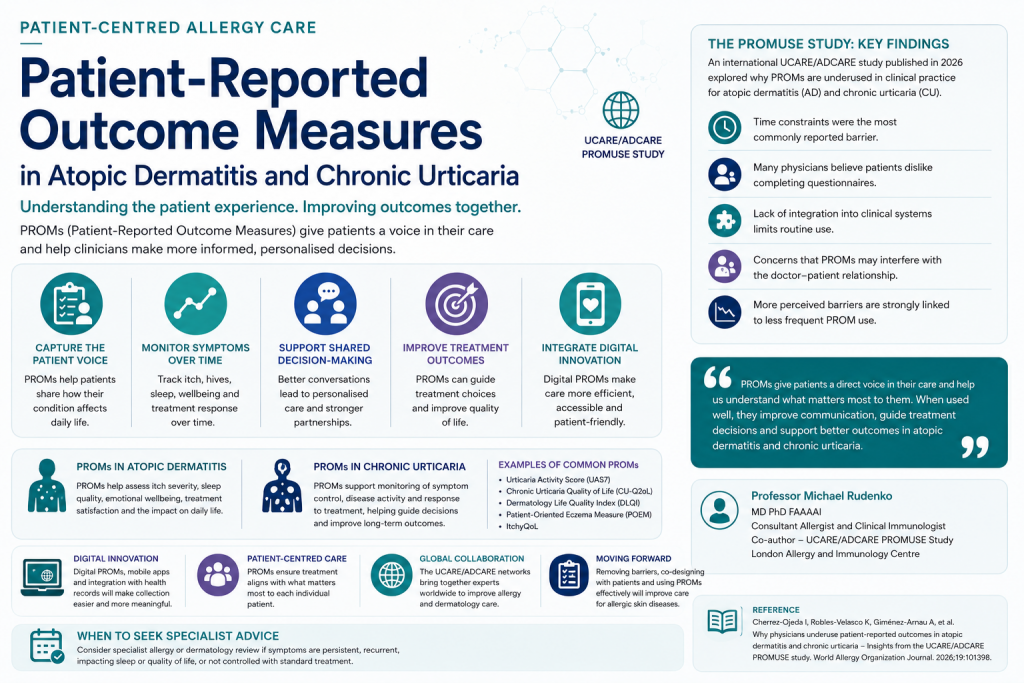
Patient-reported outcome measures help clinicians understand symptom burden, quality of life and treatment response in atopic dermatitis and chronic urticaria
What Are Patient-Reported Outcome Measures (PROMs)?
Patient-reported outcome measures (PROMs) are validated questionnaires completed by patients that assess symptoms, quality of life, treatment effectiveness and the overall impact of disease on everyday activities.
Unlike laboratory tests or physical examinations, PROMs capture the aspects of disease that only patients can truly describe. This is particularly important in conditions such as atopic dermatitis (eczema) and chronic urticaria (hives), where symptom severity, itching, sleep disruption and emotional wellbeing may fluctuate significantly between clinic visits.
PROMs help clinicians better understand the burden of disease, monitor treatment response and support shared decision-making between patients and healthcare professionals.
The PROMUSE Study: Understanding Why PROMs Are Underused
A landmark international study published in the World Allergy Organization Journal in 2026 investigated why PROMs remain underused in routine clinical practice despite their recognised value.
The PROMUSE study was conducted through the international UCARE (Urticaria Centres of Reference and Excellence) and ADCARE (Atopic Dermatitis Centres of Reference and Excellence) networks and involved physicians from specialised allergy and dermatology centres worldwide.
Importantly, Professor Michael Rudenko of the London Allergy and Immunology Centre was among the international co-authors contributing to this global collaboration examining the implementation of patient-centred outcome measures in allergic skin disease.
Key Findings
- Many clinicians recognise the value of PROMs but face practical barriers to implementation.
- Time constraints remain the most commonly reported challenge.
- Many physicians believe patients dislike completing questionnaires.
- Lack of integration into electronic health systems limits routine use.
- Some clinicians feel PROMs may interfere with the doctor-patient relationship.
- The greater the number of perceived barriers, the less likely physicians are to use PROMs regularly.
Interestingly, the study found that concerns regarding patient dissatisfaction and interference with clinical interactions were among the strongest factors associated with reduced PROM use.
Professor Michael Rudenko’s Clinical Perspective
As both a co-author of the PROMUSE study and a practising Consultant Allergist and Clinical Immunologist, I believe the findings highlight an important opportunity to improve patient-centred care in allergy and dermatology.
In everyday clinical practice, many patients experience symptoms that cannot be fully appreciated through examination alone. A patient with chronic urticaria may have minimal visible hives during a consultation but may have experienced severe symptoms throughout the preceding week. Similarly, a patient with atopic dermatitis may appear clinically improved while still suffering from significant itching, sleep disruption and reduced quality of life.
PROMs provide a structured way to capture these experiences and ensure they become part of the clinical conversation.
Importantly, PROMs should never replace clinical judgement or specialist assessment. Rather, they should complement traditional medical evaluation by helping clinicians understand the patient’s perspective more accurately.
The most effective PROMs are simple, relevant and easy to complete. They should focus on outcomes that matter most to patients while providing meaningful information that can guide treatment decisions.
Modern medicine is increasingly moving towards personalised and precision healthcare. In this context, understanding how a disease affects an individual’s daily life is becoming just as important as measuring objective disease activity.
Future developments are likely to include digital symptom tracking, integration with electronic health records, mobile health applications and more sophisticated patient-centred outcome measures developed with direct patient involvement.
Ultimately, successful allergy care requires both scientific expertise and a clear understanding of the patient’s lived experience. PROMs can help bridge that gap and support better outcomes for patients with chronic allergic diseases.
Professor Michael Rudenko MD PhD FAAAAI
Consultant Allergist and Clinical Immunologist
London Allergy and Immunology Centre
PROMs in Atopic Dermatitis
Atopic dermatitis affects millions of people worldwide and often causes substantial physical and psychological burden. Symptoms such as itching, sleep disturbance, skin pain, embarrassment and reduced self-confidence may significantly impact daily life.
PROMs help clinicians understand:
- Severity of itching
- Sleep quality
- Impact on work and school performance
- Emotional wellbeing
- Treatment satisfaction
- Long-term disease control
By incorporating patient-reported outcomes into routine care, clinicians can gain a more complete picture of disease burden and treatment effectiveness.
PROMs in Chronic Urticaria
Chronic urticaria is characterised by recurrent hives, swelling (angioedema) or both. Symptoms may fluctuate unpredictably and can have a major impact on quality of life.
Patient-reported outcome measures are particularly useful for:
- Assessing symptom control over time
- Evaluating treatment effectiveness
- Monitoring disease activity between visits
- Supporting treatment optimisation
- Identifying patients who require escalation of therapy
Several validated urticaria-specific questionnaires are now widely used in clinical research and specialist practice.
The Future of Patient-Centred Allergy Care
The future of allergy and dermatology care will increasingly focus on combining clinical expertise with patient-reported outcomes, digital health technologies and shared decision-making.
The PROMUSE study suggests that while barriers remain, clinicians and healthcare systems have an opportunity to redesign PROM implementation in a way that is both efficient and meaningful for patients.
Importantly, future PROM development should involve patients directly, ensuring that questionnaires reflect the outcomes that matter most to those living with allergic disease.
When Should You See an Allergy Specialist?
You may benefit from specialist assessment if you experience:
- Persistent eczema despite treatment
- Chronic hives lasting longer than six weeks
- Recurrent angioedema
- Sleep disturbance caused by skin symptoms
- Reduced quality of life due to allergic disease
- Uncertainty regarding diagnosis or treatment options
A specialist allergy assessment can help establish an accurate diagnosis, optimise treatment and identify factors contributing to persistent symptoms.
References
Cherrez-Ojeda I, Robles-Velasco K, Giménez-Arnau A, et al. Why physicians underuse patient-reported outcomes in atopic dermatitis and chronic urticaria: Insights from the UCARE/ADCARE PROMUSE study. World Allergy Organization Journal. 2026;19:101398.
Additional references available upon request.