
Urticaria Itchy Rash Testing and Treatment in London
Specialist assessment for recurrent hives, itching and swelling, including chronic spontaneous urticaria, autoimmune urticaria and urticaria with angioedema.
Urticaria, often called hives or nettle rash, causes itchy raised weals on the skin and may occur with deeper swelling known as angioedema. The rash is called nettle rash because it can look very similar to the reaction seen after touching a stinging nettle.
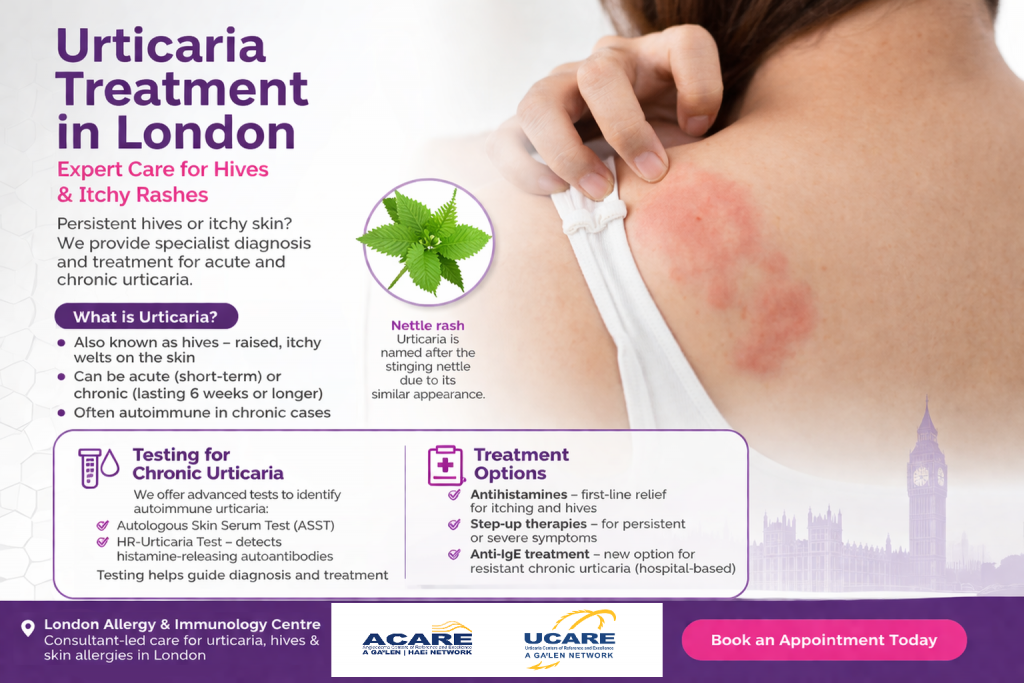
Specialist care for urticaria (hives), itchy rash and chronic spontaneous urticaria in London
Some episodes are short lived and settle within days or weeks, while others continue for more than 6 weeks and are then classified as chronic urticaria. Modern guidelines divide chronic urticaria into chronic spontaneous urticaria, where hives appear without a consistent external trigger, and chronic inducible urticaria, where symptoms are brought on by factors such as pressure, cold, heat, vibration, exercise or scratching.
Chronic spontaneous urticaria can have a major effect on sleep, work, concentration and quality of life. Specialist review is important because hives are not all the same, and the right diagnosis helps guide the right treatment and the right level of investigation.
Chronic spontaneous urticaria is usually not caused by food allergy, and extensive food avoidance is often unnecessary unless the clinical history clearly suggests a relevant trigger.

Urticaria affects many people at some stage in life
Hives lasting more than 6 weeks
May occur with deeper swelling as well as weals
Diagnosis, targeted testing and modern treatment planning
What is urticaria?
Urticaria causes transient itchy swellings of the skin known as weals or hives. These are often pale in the centre, red around the outside and may change shape, size or location over hours. Some patients also develop angioedema, which is a deeper swelling that can affect the lips, eyelids, hands, feet or other areas.
- Acute urticaria lasts up to 6 weeks
- Chronic urticaria lasts more than 6 weeks
- Symptoms may include itching, burning, flushing and swelling
- Individual weals usually come and go, even when the overall condition persists
What causes urticaria?
Urticaria occurs when mast cells in the skin release histamine and other inflammatory mediators. This leads to itching, redness and swelling. In chronic spontaneous urticaria, this release happens without a reliable external trigger.
Modern understanding recognises that chronic spontaneous urticaria can involve different immune patterns, including autoimmune forms. In some patients, antibodies or other immune signals activate mast cells and basophils, helping explain why symptoms can become persistent or difficult to control.
Autoimmune urticaria and modern understanding of CSU
Type I autoallergic CSU
Some patients appear to have IgE-driven reactions against self-antigens, sometimes called autoallergic CSU. This may behave differently from classic type IIb autoimmune disease.
Type IIb autoimmune CSU
In this form, IgG autoantibodies may activate mast cells and basophils via IgE or its high-affinity receptor. This pattern is often linked with more severe or harder-to-control disease.
Why this matters
Understanding the likely disease pattern may help explain severity, guide targeted testing in selected cases and support more personalised treatment decisions.
Symptoms of urticaria
- Itchy, raised weals or hives
- Redness or flushing of the skin
- Swelling that moves from place to place
- Angioedema affecting lips, eyelids, hands or feet
- Sleep disturbance, distress and reduced quality of life
Although the rash can look dramatic, the pattern, duration and associated swelling are very important in deciding whether the problem is acute urticaria, chronic spontaneous urticaria, inducible urticaria, angioedema, or another condition that can mimic hives.
How common is autoimmune urticaria?
Older descriptions often grouped about half of chronic urticaria patients under autoimmune urticaria. More recent literature suggests a more nuanced picture, with different endotypes and biomarkers rather than one single mechanism for all patients.
In practice, some patients clearly show features suggesting autoimmune disease, while others have chronic spontaneous urticaria without a definite biomarker pattern. This is one reason why specialist interpretation is important.
Testing for chronic spontaneous urticaria
Targeted testing rather than excessive screening
Most patients with chronic spontaneous urticaria do not need very broad allergy screening. Investigations are usually based on the history, examination and whether there are clues to autoimmune disease, inflammation, infection, thyroid involvement, inducible triggers or an alternative diagnosis.
Assessment tools
Modern specialist care often uses structured tools such as UAS7 to measure disease activity, UCT to assess disease control, and AAS where angioedema is a major feature. These help monitor progress over time and guide treatment decisions.
Basophil tests and autoimmune markers
Basophil histamine release assays and basophil activation tests can support the diagnosis of type IIb autoimmune chronic spontaneous urticaria in selected patients. These tests are more informative than the older assumption that all positive ASST-type reactions are equivalent.
Other biomarkers
Recent literature also discusses low total IgE, eosinopenia, basopenia and anti-thyroid peroxidase antibodies as biomarkers that may point towards type IIb autoimmune disease, especially when interpreted together rather than in isolation.
Does chronic urticaria mean allergy?
Usually no
Chronic spontaneous urticaria is usually not caused by food allergy. Many patients understandably search for a dietary explanation, but in long-standing spontaneous urticaria the cause is more often internal immune dysregulation than a true food allergy.
When allergy testing may still help
Allergy testing may still be useful if the history suggests an immediate trigger, for example a reproducible reaction after a specific food, medication, insect sting or latex exposure, or if the diagnosis is uncertain and another allergic condition is possible.
What treatment is available?
First-line treatment
Non-sedating second-generation H1 antihistamines are the main first-line treatment. In chronic spontaneous urticaria they are often taken regularly rather than only during flares.
When symptoms remain uncontrolled
If standard dosing is not enough, guidelines support increasing the dose of second-generation antihistamines up to fourfold in appropriate patients under medical supervision.
Biologic treatment
For patients who remain uncontrolled despite optimised antihistamine treatment, anti-IgE therapy with omalizumab is an established next step. This has become a key option for resistant chronic spontaneous urticaria and is used according to specialist criteria.
Further escalation
In selected difficult cases that remain uncontrolled, ciclosporin may be considered in specialist care. Treatment choice depends on severity, coexisting disease, previous response and safety considerations.
Short courses in selected situations
Short courses of oral corticosteroids may sometimes be used for severe flares, but they are not suitable as a long-term solution for chronic urticaria.
Ongoing review
The goal is complete control where possible. Recent practice increasingly emphasises treat-to-target care, regular review and stepping treatment up or down according to symptom control.
How long can chronic urticaria last?
The duration varies from person to person. Some patients improve within months, while others have disease that continues for several years. Autoimmune-pattern disease can sometimes be more persistent, but long-term outcomes are variable and treatment can still greatly improve quality of life and symptom control.
Because chronic urticaria can fluctuate over time, it is important not to assume that persistent symptoms mean treatment will never work. Regular review helps identify response, adjust treatment and decide when step-down may be appropriate.
Looking for urticaria testing and treatment in London?
We provide specialist assessment for chronic spontaneous urticaria, autoimmune urticaria, recurrent hives and angioedema, with targeted investigations and guideline-based treatment planning.
We can help review whether your rash fits chronic spontaneous urticaria, whether testing is needed, and whether advanced treatment options should be considered.
Selected references
- The international EAACI/GA²LEN/EuroGuiDerm/APAAACI guideline for the definition, classification, diagnosis and management of urticaria. 2026 update.
- BSACI chronic urticaria and angioedema resources and urticaria guidance.
- Kolkhir P, et al. Chronic spontaneous urticaria: review of diagnosis, burden and treatment. 2024.
- Bernstein JA, et al. Diagnostic testing for chronic spontaneous urticaria with or without angioedema. 2025.
- Recent reviews on CSU endotypes, biomarkers and personalised treatment pathways, 2025–2026.
This page is intended for general educational purposes and does not replace individual medical advice. Urticaria diagnosis and treatment should be based on specialist assessment.