
Intranasal Adrenaline: The Needle-Free Revolution in Anaphylaxis Treatment
Posted: 28th February 2026 | Posted by allergy
A nasal spray that delivers the same life-saving medication as an injection — no needles, no fear, no complicated technique. Here is everything you need to know about intranasal adrenaline, backed by the latest medical evidence.
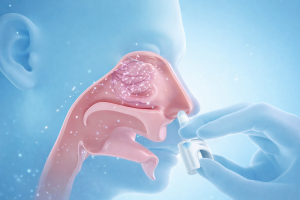
Adrenaline nasal spray being administered into the nasal passage, highlighting the internal structures and distribution of particles
Imagine being at a restaurant when a friend with a severe food allergy suddenly develops anaphylaxis — their throat tightening, skin erupting in hives, blood pressure plummeting. You reach for their emergency medication, but it is a needle-based auto-injector. If you or your friend have a fear of needles, hesitation in those crucial seconds could be fatal.
That scenario has driven decades of research into alternative ways to administer adrenaline, the only first-line medication proven to reverse a severe allergic reaction. In August 2024, the U.S. Food and Drug Administration (FDA) approved the first-ever nasal spray formulation of adrenaline for the emergency treatment of anaphylaxis — a milestone described by allergists worldwide as a potential game-changer for patient safety.
In Europe, the picture is evolving rapidly. The European Medicines Agency approved the first nasal spray formulation of adrenaline in August 2023, and the UK’s Medicines and Healthcare products Regulatory Agency (MHRA) followed with its own approval in July 2025 — making the UK the first country in the region to license a needle-free emergency treatment for anaphylaxis.
As in the US, allergists and patient advocates across Europe have welcomed the development as a significant step forward for people who struggle with auto-injectors due to needle phobia, dexterity issues, or the stress of an acute allergic reaction — though clinicians stress that decisions about which formulation is most appropriate should be made on an individual basis.
This article explains what intranasal adrenaline is, what the science says, who it is designed for, and what it means for people living with severe allergies.
of people in the US have experienced anaphylaxis at some point in their lives
deaths per year in the US are attributed to anaphylaxis
of adults with severe food allergy have actually been prescribed an adrenaline auto-injector
What Is Anaphylaxis — And Why Does Timing Matter So Much?
Anaphylaxis is a severe, potentially life-threatening allergic reaction. It can be triggered by foods (such as peanuts, tree nuts, shellfish, or milk), insect stings, medications, latex, and sometimes exercise. The reaction is rapid — symptoms can escalate within minutes — and involves multiple organ systems simultaneously: the skin, airway, circulatory system, and gastrointestinal tract.
The World Allergy Organization estimates that anaphylaxis occurs globally at a rate of 50 to 112 episodes per 100,000 people per year, and among high-risk individuals, recurrence rates range from 26% to 54%. Despite how common it is, anaphylaxis is consistently under-treated, particularly in out-of-hospital settings. Delayed or absent adrenaline administration is the most common factor in anaphylaxis-related deaths.
“Delayed administration of adrenaline can lead to more severe outcomes such as prolonged reactions, hypotension, and increased mortality.”
— Emergency Medicine Research & Analysis, 2025
Adrenaline counters anaphylaxis by constricting blood vessels, relaxing the airways, reducing hives and swelling, and stimulating the heart. It works within minutes and remains the only medication endorsed as first-line treatment by every major international allergy guideline, including those from the World Allergy Organization, the European Academy of Allergy and Clinical Immunology (EAACI), and the American Academy of Allergy, Asthma & Immunology (AAAAI).
The Problem With Traditional Auto-Injectors
For decades, the standard method of emergency adrenaline delivery has been the auto-injector — a spring-loaded device that injects the medication intramuscularly (usually into the outer thigh). Auto-injectors are highly effective, but they come with real-world barriers that have always troubled clinicians and patients alike.
Common barriers to auto-injector use
- Needle phobia — one of the most frequently cited reasons for hesitation
- Fear of accidentally injuring someone (especially in bystander situations)
- Needle length variability: in patients with obesity, the needle may not reach the muscle
- Risk of incorrect technique under panic conditions
- Relatively short shelf life; must be stored at specific temperatures
- High cost and barriers to access in some countries
- Inconvenient size and shape — many patients leave them at home
A 2022 US survey found that approximately 36% of adults with severe food allergy believed adrenaline auto-injectors could cause life-threatening side effects — a misconception that leads to dangerous hesitation. Meanwhile, researchers have long observed that needle phobia is widespread, and that parents in particular are reluctant to inject a child or a loved one.
These barriers have directly motivated the search for a needle-free alternative that can deliver adrenaline rapidly, reliably, and without any injection technique at all.
How Does Intranasal Adrenaline Work?
The nasal route has been used for decades to deliver medications — from decongestants to hormone therapies — because the nasal mucosa is richly supplied with blood vessels and can absorb drugs quickly into the systemic circulation.
Intranasal adrenaline is delivered as a fine spray directly into one nostril. The medication crosses the nasal lining into the bloodstream without any injection. Clinical research shows that when the correct formulation is used, the speed of absorption is comparable to — and in some formulations, faster than — intramuscular injection.
A 2025 systematic review presented at the European Emergency Medicine Congress (Vienna) analysed five clinical studies comparing intranasal and intramuscular adrenaline. The researchers found that intranasal adrenaline achieved its peak plasma concentration in 2.5 to 30 minutes, compared to 9 to 45 minutes for the intramuscular route — suggesting that, depending on the formulation and individual nasal characteristics, the nasal spray can reach the bloodstream at least as rapidly, and sometimes more rapidly.
“Nasal sprays could become a suitable and equally effective needle-free alternative to the EpiPen, which is the current treatment for anaphylaxis.”
— Dr. Danielle Furness, University of Buckingham, European Emergency Medicine Congress 2025
What the Clinical Evidence Shows
The FDA’s 2024 approval of the first intranasal adrenaline product was supported by rigorous pharmacokinetic and clinical trial data. Here is what current medical research tells us:
Comparable effectiveness to injection
A landmark Phase 3 prospective trial showed that all 15 participants who received intranasal adrenaline during an oral food challenge responded successfully to a single dose, with no requirement for a second dose to control the reaction. Separate real-world data collected from over 500 patients treated by clinicians in the United States showed an approximately 89% success rate with a single dose — a figure that closely matches the historic success rates of intramuscular injection and autoinjectors across published meta-analyses.
Faster or comparable absorption
Pharmacokinetic studies have consistently shown that well-formulated intranasal adrenaline achieves plasma levels similar to or higher than intramuscular adrenaline. The 2025 dose-optimisation study published in the Journal of Allergy and Clinical Immunology: Global confirmed that nasal powder formulations in particular enable fast, high absorption within the short therapeutic window critical for anaphylaxis treatment.
Interestingly, nasal congestion does not appear to be a barrier
One concern researchers initially raised was whether nasal congestion — common during an allergic reaction — might reduce absorption. However, clinical studies have actually observed that nasal congestion can enhance adrenaline absorption through the nasal mucosa, likely due to increased local blood flow, addressing a key theoretical concern about the nasal route.
Well-tolerated safety profile
Published research in peer-reviewed journals has consistently described intranasal adrenaline as well tolerated. The side effect profile mirrors that of injected adrenaline (such as transient increase in heart rate and mild anxiety) but avoids injection-site pain, bruising, and the risk of inadvertent intravenous injection. A 2024 review in the Journal of Allergy and Clinical Immunology found no evidence of severe adverse reactions specific to the nasal route.
Effective for children and adults
A 2025 review published in Current Opinion in Allergy and Clinical Immunology specifically examined the evidence for intranasal adrenaline in the paediatric setting. The authors concluded that it represents a “promising, well-tolerated option that could significantly improve the accessibility and effectiveness of anaphylaxis management” in children — a population where needle fear is particularly acute and accurate injection technique especially difficult to achieve under stress.
Intranasal Adrenaline vs. Auto-Injector: A Quick Comparison
| Feature | Intranasal Spray | Auto-Injector (Injection) |
|---|---|---|
| Delivery method | Nasal spray — no needles | Intramuscular injection (thigh) |
| Needle required | No | Yes |
| Speed of absorption | 2.5–30 min (comparable or faster) | 9–45 min |
| Ease of use under stress | High — single-step nose spray | Moderate — requires correct technique |
| Needle phobia barrier | Eliminated | Significant for many patients |
| Body weight variability | Not affected by adipose tissue | Needle may not reach muscle in obese patients |
| FDA-approved for anaphylaxis | Yes (2024, adults & children ≥30 kg) | Yes (long-established) |
| Suitable as first-line treatment | Yes — per 2024 GA²LEN consensus | Yes — longstanding first-line standard |
Who Can Use Intranasal Adrenaline?
Following FDA approval in August 2024, intranasal adrenaline is indicated for the emergency treatment of Type 1 allergic reactions, including anaphylaxis, in adults and children weighing at least 30 kilograms (approximately 66 pounds). It is intended for use as an emergency rescue treatment — not a preventive or routine medication.
The approved dosing protocol (per the 2024 GA²LEN anaphylaxis consensus tool) is one spray (2 mg adrenaline) into one nostril. If symptoms do not improve or worsen after 5 minutes, a second dose may be administered in the same nostril using a new spray device.
⚠ Important: Call emergency services immediately
Intranasal adrenaline — like all forms of emergency adrenaline — is a bridge to definitive medical care, not a substitute for it. Anyone who receives adrenaline for anaphylaxis must be taken to an emergency department immediately, even if they feel better. Biphasic reactions (a second wave of symptoms hours later) can occur without warning. Always call emergency services as soon as possible.
What Do Current Allergy Guidelines Say?
The 2024 GA²LEN Anaphylaxis Consensus Report — a major international agreement involving multiple allergy organisations — formally incorporated intranasal adrenaline into its anaphylaxis clinical support tool alongside intramuscular auto-injectors. This reflects a significant shift in global medical thinking.
The Resuscitation Council UK’s updated anaphylaxis evidence review (2025) continues to establish adrenaline as the unambiguous first-line treatment for anaphylaxis, and notes the evolving evidence base for needle-free delivery methods. Researchers in the UK have called for intranasal adrenaline to be incorporated into national guidelines “once strong, real-world evidence supports its safety and effectiveness” — with initial rollout to include close monitoring and systematic outcome reporting.
The EAACI (European Academy of Allergy and Clinical Immunology), which last updated its major anaphylaxis guidelines in 2021, is expected to incorporate needle-free alternatives in forthcoming revisions as real-world evidence continues to accumulate.
Why This Matters for Everyday People With Allergies
For patients and their families, the practical implications of a nasal spray option are significant. Consider the following scenarios where intranasal delivery could be transformational:
Children at school: Teachers and school staff are sometimes reluctant to use an auto-injector on a child experiencing anaphylaxis, even with training, due to fear of the needle. A nasal spray could be easier to administer confidently by non-medical personnel in an emergency.
Adolescents managing their own allergy: Teenagers are a high-risk group for anaphylaxis fatalities precisely because they often fail to carry or use their adrenaline auto-injector. A spray that fits in a pocket and involves no needle may meaningfully improve adherence.
Bystanders at public events: In out-of-hospital settings — restaurants, airports, sporting venues — the likelihood of a willing bystander using an auto-injector on a stranger is low. The nasal route dramatically lowers the psychological barrier to intervention.
Patients with obesity: Studies have shown that standard auto-injector needle lengths may fail to reach the muscle in patients with greater adipose tissue, resulting in subcutaneous rather than intramuscular delivery. The nasal route is unaffected by body composition.
Are There Any Limitations or Concerns?
While the evidence is encouraging, researchers and clinicians urge balanced perspective. Intranasal adrenaline is a powerful advance, but several areas warrant ongoing attention:
Weight restriction: The current approval covers patients weighing at least 30 kilograms. Smaller children — including infants and toddlers, who are a particularly high-risk group — cannot yet use the approved product, and different dosing considerations apply.
Real-world evidence is still maturing: Although the real-world data collected in 2025 from over 500 patients is highly encouraging, the clinical trials supporting approval included relatively small populations. Larger post-market studies will be important to confirm long-term safety and effectiveness across diverse patient groups.
Not a replacement for medical education: Patients and carers still need clear instruction on when and how to use any adrenaline device, whether injection or nasal spray. Training and anaphylaxis action plans remain essential.
Access and cost: As a recently approved product in the United States, insurance coverage and affordability may vary. International regulatory approvals are still pending in many countries.
What Should You Do If You or Someone You Know Has Severe Allergies?
Whether you opt for an auto-injector, an intranasal spray, or carry both, the single most important principle remains unchanged: adrenaline must be accessible, and you must know how to use it. Here are steps every person with a serious allergy — or anyone who cares for one — should take:
Practical steps for people at risk of anaphylaxis
- Discuss all available adrenaline options with your allergist or GP, including intranasal sprays
- Always carry your prescribed emergency adrenaline — and ensure it has not expired
- Have a written anaphylaxis action plan and share it with family, school, and workplace
- Know the early signs of anaphylaxis: hives, throat tightening, dizziness, vomiting, difficulty breathing
- Use adrenaline at the first sign of anaphylaxis — do not wait to see if antihistamines work
- Call emergency services (999 / 112 / 911) immediately after giving adrenaline
- Go to hospital even if symptoms improve — biphasic reactions can occur hours later
- Review and practise your adrenaline technique or spray technique regularly
The Bottom Line
Intranasal adrenaline represents one of the most meaningful advances in allergy emergency medicine in a generation. For the first time, patients and bystanders have access to an FDA-approved, needle-free option to treat a life-threatening allergic reaction — one that the latest clinical evidence shows to be at least as effective as traditional injection for adults and most children.
It will not replace conventional auto-injectors overnight, and the global medical community rightly calls for further real-world evidence and guideline integration. But for the millions of people who carry adrenaline every day — and the many more who do not carry it at all — this innovation has the potential to save lives that might otherwise be lost to hesitation, needle phobia, or simply not having the device at hand.
Speak to your doctor or allergist to find out whether intranasal adrenaline is the right option for you or your child. The most important thing is that when anaphylaxis strikes, you are prepared — and ready to act.
Sources & Further Reading
- Crescioli G, et al. “Adrenaline nasal spray for the treatment of anaphylaxis: perspectives in paediatrics.” Current Opinion in Allergy and Clinical Immunology. 2025;25(6):511–517.
- Ebisawa M, Muraro A, Worm M, et al. “Optimizing Adrenaline Administration in Anaphylaxis: Clinical Practice Considerations and Safety Insights.” Clinical and Translational Allergy. 2025;15(8):e70085.
- Furness D, et al. Systematic literature review on intranasal vs intramuscular adrenaline for anaphylaxis. Presented at: European Emergency Medicine Congress; September 2025; Vienna, Austria.
- Lapidot T, Tal Y, Megiddo D, et al. “First-in-class intranasal adrenaline spray for anaphylaxis: Dose finding clinical study.” Journal of Allergy and Clinical Immunology: Global. 2025;4(3):100487.
- Campbell RL, et al. “Anaphylaxis definition, overview, and clinical support tool: 2024 consensus report — a GA²LEN project.” Journal of Allergy and Clinical Immunology. 2025. doi:10.1016/j.jaci.2025.00072.
- U.S. Food and Drug Administration. “FDA approves first nasal spray for treatment of anaphylaxis.” August 2024. fda.gov
- Cardona V, Ansotegui IJ, Ebisawa M, et al. “World Allergy Organization Anaphylaxis Guidance 2020.” World Allergy Organization Journal. 2020;13(10):100472.
- Dodd A, et al. “Evidence update for the treatment of anaphylaxis.” Resuscitation. Resuscitation Council UK, 2025.