Latest News and Info

Urticaria Allergic rhinitis Mental health

ACARE & UCARE Accredited Centre

Mind, Mucosa and Skin

How chronic urticaria, allergic rhinitis and psychological wellbeing can affect one another

At the London Allergy and Immunology Centre, we take a whole-person view of allergy care. New research highlights that chronic spontaneous urticaria, nasal allergy symptoms and emotional wellbeing are often closely connected. This matters because better understanding of this link can help patients access more complete and effective care.

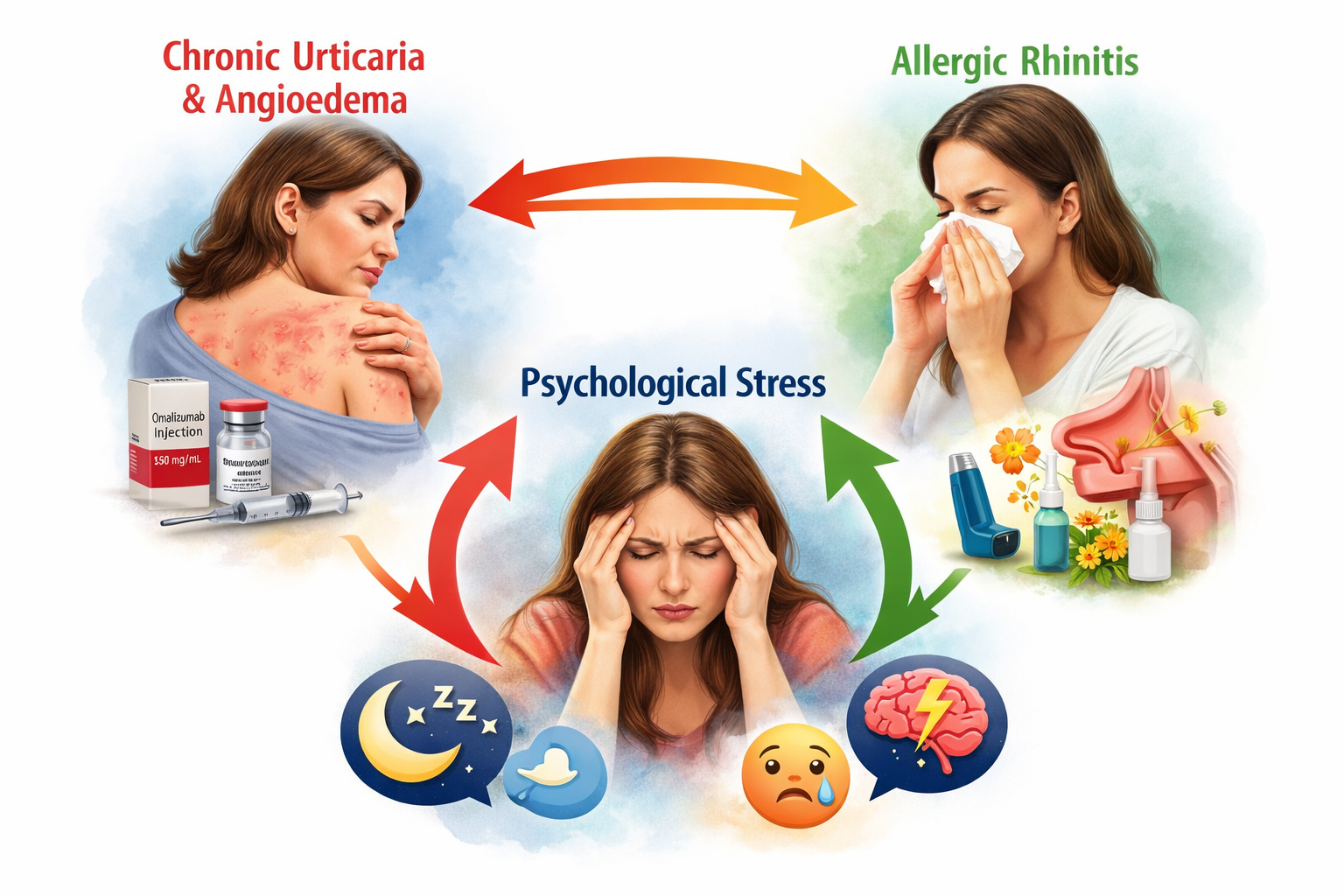
The link between chronic urticaria hives, allergic rhinitis symptoms and psychological stress in allergy patients

The connection between chronic urticaria, allergic rhinitis and psychological stress affecting overall wellbeing.

Why this matters for patients with allergy and urticaria

Chronic spontaneous urticaria, often called CSU, is more than a skin rash. It can disrupt sleep, affect confidence, interfere with work and family life, and create constant uncertainty because symptoms may flare without warning. When allergic rhinitis is also present, the burden can become even greater. Nasal blockage, sneezing, poor sleep and persistent irritation may add to fatigue and emotional strain.

A 2026 study explored this triad of mind, mucosa and skin and showed that psychiatric comorbidities were very common among adults with antihistamine-refractory CSU receiving omalizumab. The findings support a more integrated model of care in which allergy, skin symptoms, sleep and mental wellbeing are considered together rather than separately.

What is chronic spontaneous urticaria?

Urticaria is characterised by itchy raised wheals, angioedema, or both. When symptoms persist for more than 6 weeks, the condition is defined as chronic urticaria. If the rash and swelling occur without a clear external trigger, it is called chronic spontaneous urticaria.

Many patients improve with antihistamines, but some continue to have frequent symptoms despite treatment. In these more difficult cases, specialist assessment is important to confirm the diagnosis, identify associated conditions, assess disease activity properly and consider advanced treatment options such as omalizumab where appropriate.

Common features of CSU
– Recurrent itchy wheals
– Swelling of the lips, eyelids, hands or other areas
– Symptoms lasting longer than 6 weeks
– Unpredictable flare-ups
– Sleep disturbance and reduced quality of life

What did the 2026 study find?

The study reviewed 72 adults with antihistamine-refractory CSU who received omalizumab and had a formal psychiatric evaluation at a tertiary allergy centre between 2015 and 2025. Most participants were female, with a median age of 45 years. Psychiatric diagnoses were identified in 90.3% of the cohort who underwent psychiatric assessment.

The most frequent psychiatric diagnostic group was anxiety disorders, followed by mood disorders and sleep-wake disorders. Generalised anxiety disorder was the single most common diagnosis. The authors also reported that allergic rhinitis was present in more than half of the cohort, suggesting an important upper-airway allergic burden in this patient group.

Study finding Result
Patients included 72 adults with antihistamine-refractory CSU treated with omalizumab
Female participants 70.8%
Median age 45 years
Any psychiatric comorbidity 90.3%
Most common psychiatric group Anxiety disorders
Allergic rhinitis in the cohort 51.4%

The stress-skin connection in chronic urticaria

Patients often tell us that stress seems to aggravate their hives. This fits with what clinicians and researchers have observed for many years. Chronic urticaria can itself be stressful because flare-ups are unpredictable and visible. At the same time, stress may influence inflammatory pathways, itch perception and symptom severity, which can then further increase anxiety and distress. This creates a self-perpetuating cycle.

The 2026 paper describes this as a close interaction between psyche and skin. Biological pathways thought to be involved include stress-related neuroimmune signalling and mast cell-mediated inflammation. For patients, the important message is simple: the symptoms are real, the burden is real, and both the physical and emotional impact deserve proper attention.

This does not mean urticaria is “just stress”. Rather, it means stress, sleep problems, allergy symptoms and inflammation may all affect one another. That is why good management often requires more than a prescription alone.

Response to treatment in the study

Under omalizumab treatment, disease control improved significantly in this cohort. Median UAS7 scores fell from 42 before treatment to 7 at 24 months, while UCT scores rose from 0 to 14. These results support the role of specialist treatment in patients whose symptoms remain poorly controlled on antihistamines alone.

The authors also noted that improving urticaria control may bring psychological benefits and better emotional wellbeing. In practice, this reinforces the importance of identifying uncontrolled disease early and ensuring that patients receive an expert review rather than simply repeating ineffective treatment.

What this means for care at our ACARE and UCARE accredited centre

As an ACARE and UCARE accredited centre, we believe patients with chronic urticaria deserve expert, evidence-based and compassionate care. This includes careful diagnosis, assessment of angioedema and inducible triggers, review of coexisting allergic diseases such as allergic rhinitis and asthma, and evaluation of how symptoms are affecting sleep, mood and daily functioning.

Where appropriate, management may involve optimisation of antihistamines, consideration of advanced treatment pathways, investigation of associated conditions and practical support around trigger awareness, sleep hygiene and stress reduction. In some cases, collaboration with other professionals may be helpful so that care is truly patient-centred and holistic.

For patients, the key message is that severe hives and swelling are not only skin symptoms. They can affect confidence, sleep, relationships and quality of life. Recognising that full burden is an important step towards better outcomes.

When to seek specialist urticaria assessment

– Your hives or swelling have lasted longer than 6 weeks
– Symptoms keep returning despite antihistamines
– You have troublesome angioedema
– Sleep is regularly disturbed by itch or nasal symptoms
– You feel that stress, anxiety or low mood are making symptoms harder to manage
– You may have both urticaria and allergic rhinitis

Book an expert review

If you are living with chronic hives, angioedema or allergic rhinitis, our specialist team can help assess the full picture and create a personalised plan. We offer consultant-led allergy care with a focus on accurate diagnosis, better symptom control and improved quality of life.

Book an appointment

Reference

This article is based on the 2026 paper by Zeynep Yegin Katran, İsmet Bulut, Andaç Salman, Ali Baz, Galip Muzaffer Kürşat Küçükali and Özge Argın, which examined the relationship between chronic spontaneous urticaria, allergic rhinitis and psychiatric comorbidities in omalizumab-treated adults.

Please note that this blog is for general education and does not replace personalised medical advice. Diagnosis and treatment should always be based on an individual clinical assessment.


My eyes are watering and won’t stop itching. What do I do?

My eyes are watering and won’t stop itching. What do I do?

Do you find yourself constantly battling itchy, watery eyes or dealing with a nose that seems determined to run a marathon? Perhaps an unexplained rash is driving you to distraction with relentless itching. These discomforts are familiar to many of us, but when they persist, they might be a sign that you’re having an allergic reaction.

Allergies can show up in various ways, and while they can range from minor inconveniences to serious health concerns, they often share common symptoms, such as sneezing, hives, skin redness, swelling, stomach discomfort, or even respiratory issues.

You might think allergies are all about sudden, life-threatening reactions like anaphylactic shock, but there’s more to the story. There are four distinct types of allergic reactions, each with unique characteristics. Let’s explore them together.

Immediate allergic reactions (Type I)

These reactions are like a lightning bolt, happening within seconds to minutes. Anaphylactic reactions are the most severe and can cause life-threatening issues like difficulty breathing and severe swelling. They’re triggered by antibodies in response to allergens like pollen or certain foods.

Cytotoxic reactions (Type II)

Type II reactions take a bit more time, usually minutes to hours. Here, antibodies trigger the immune system’s complement system, potentially leading to autoimmune hemolytic anaemia, immune thrombocytopenia, and autoimmune neutropenia. These reactions are linked to diseases like Goodpasture syndrome and Graves’ disease, adding intrigue to the allergy narrative.

Immune complex-mediated reactions (Type III)

These reactions don’t rush in; they take several hours to show their effects. Antibodies collaborate with allergens to create immunocomplexes, which can contribute to autoimmune conditions like lupus and serum sickness. The complex dance of these antibodies adds depth to our understanding of allergies.

Delayed hypersensitivity reactions (Type IV)

Type IV reactions are patient and can appear hours or even days after exposure. They’re often linked to persistent infections, such as tuberculosis or fungal infections, creating an intricate interplay between the immune system and these pesky invaders.

What should you do if you suspect you have an allergy?

Unchecked symptoms can lead to discomfort and potential complications regardless of the type. For immediate and severe reactions, call 999 and seek immediate medical attention if you experience symptoms like severe rashes, swelling of the lips or throat, difficulty breathing, or fainting.

For milder allergies, it’s time to take action. Testing can help identify your triggers, allowing you to manage your allergies and regain control over your well-being proactively. Don’t let allergies hold you back; take the first step towards a more comfortable and allergy-aware life.

Take the guesswork out of living a comfortable life. Let’s take the first steps to discover what’s bringing you discomfort. Our allergy experts can guide you through the process, from testing to advice. Simply register as a new patient or call us on 02031 433 449.

Urticaria Day 2021: everything you should know about this skin condition

Urticaria Day

Urticaria Day 2021: everything you should know about this skin condition

It’s almost October 1st again, which means Urticaria Day is just around the corner. This day is a great time to highlight a condition people don’t talk about enough.

So we thought today we’d answer some frequently asked questions about this common ailment, as well as sharing how you can get involved in this year’s event, building awareness and sharing your support.

What is urticaria?

Urticaria is a skin affliction which you might more commonly know as hives, weals, welts, and nettle rash. It involves raised, extremely itchy rashes and bumps on the skin.

These rashes might be present on an isolated part of the body or spread across larger areas. They can also vary from being a few millimetres in size to being around the size of a hand. 

The condition has two varieties: acute and chronic urticaria. The former is when the rash clears completely within six weeks, while the latter is if the rash persists for more than six weeks.

Who does it affect?

Urticaria is a common condition that affects around 1 in 5 people at some point in their lives. Most frequently, it’s experienced by children, women aged 30-60, and those with a previous history of allergies.

What causes it?

Urticaria appears when something triggers the body to produce high levels of histamine and other chemical messengers. This causes the blood vessels to open and leak – causing redness and itchiness, respectively.

Triggers might include an allergic reaction, infection, heat/cold exposure, or certain medications. Caffeine, alcohol, stress, and warm temperatures can also make symptoms worse.

Can it be treated?

If you experience urticaria, and your symptoms don’t go away within 48 hours, you’ll want to speak with your GP. The same goes for anything you find distressing, distracting from your daily life, or appearing in combination with other symptoms.

In milder cases, rashes will usually clear on their own within a few days. But you can always take over-the-counter antihistamines to relieve some of the itching and discomfort.

What is Urticaria Day?

Taking place every October 1st since 2014, Urticaria Day is all about building awareness, establishing communities, and showing solidarity with those struggling with urticaria. 

A lot of people find their symptoms distressing, embarrassing, or isolating, making it even more important to encourage widespread education on the condition, its cause, and its prevalence.

To get involved, why not share your experience with others? If you haven’t experienced it yourself, you could take some time to learn the key facts or share information using #WorldUrticariaDay.

Urticaria is an incredibly common condition that will impact many of us throughout our lives. And because of this, it warrants greater conversation and awareness. To read more, you can check out some of our previous posts in honour of Urticaria Day here and here.

If you believe an allergy might be triggering your urticaria flare-ups, or are suffering any other symptoms of a reaction, get in touch with the London Allergy and Immunology Centre to book an allergy test. Call us today on 02031 433 449. And to show your support for Urticaria Day, head over to the official website to find out how you can help.

World urticaria day UCARE 2018

world urticaria day

World urticaria day 2018

You will know October for Halloween, but there’s another essential date to add to your calendars. The 1st of October is World Urticaria Day, and 2018 is the fifth iteration of the global event. It helps to raise awareness of the condition and bring people together. But what is urticaria and what causes it?

What is it?

You might not recognise the clinical name of the condition, but you have probably heard of hives, weals, and welts. These names are commonly used in place of urticaria. It usually manifests on the body in itchy and angry looking bumps. Although it sometimes appears on just a patch of skin, it can, unfortunately, spread to many parts of the body.

Often, the rash will clear up in as little as 24 hours; however, this isn’t always the case. It may affect the skin for about six weeks before disappearing, something called acute urticaria. But in some severe cases, the condition can be chronic and will come and go over many years.

In rare cases, individuals may suffer from urticaria vasculitis; this causes the blood vessels in the skin to become inflamed. Although this type doesn’t last for years like chronic urticaria does, it can last for more than 24 hours and sometimes leaves bruises.

Causes

Acute urticaria affects about 1 in 5 people throughout a lifetime, and people who suffer from allergies are likely to be more at risk.

The condition can be triggered when high levels of histamine and other chemicals are released into the skin, usually as a result of exposure to allergens. The blood vessels then open up, causing the skin to turn red and potentially ‘weep’, leading to itchiness. If you suffer from this, it is advised that you stay clear of alcohol, stress, and warm temperatures as this can make symptoms get worse.

If you suffer consistently for six weeks or more, it isn’t likely to be a result of an allergy. However, if you have experienced it for less time than this, it is critical that you are allergy tested to make sure you know what is causing it.

Awareness

Urticaria can become unbearable and can cause emotional distress; it sometimes even leads to depression. It can affect day to day life, and figures show that 1 in 7 people who suffer from chronic urticaria will experience emotional problems as a result.

Not everybody is aware of the skin affliction, and the effects it can have on a person’s life. The reality is that this is a far more common illness than people realise and we are spreading awareness. As an allergy clinic, sharing information about how allergies can affect people’s lives in big and small ways is essential to us.

This year’s slogan is “Do Better!” Because we can do more to raise awareness. This world urticaria day, search for the hashtags, #uday or #urticariaday, to find out about more people’s experiences of living with the illness, how you can help, and symptoms to look out for.

If you suspect you may be affected by urticaria, book an appointment with one of our experts in UCARE (Urticaria Centre of Reference and Excellence) London Allergy and Immunology Centre.

Copyright 2026. All Rights Reserved

LAIC Main Menu